Moving water demands a different toolbox than paddling flat ponds. The current demands dynamic response, and the three maneuvers that separate confident river runners from kayakers paddling in fear are the ferry, the eddy turn, and the peel out. These techniques aren't optional flourishes; they're survival skills that give you precise control when the water is pushing back. A ferry lets you traverse a current without being swept downstream. An eddy turn plants you firmly in calm water, turning a threat into an asset. A peel out lets you leave that safety zone decisively, aligned with the current instead of fighting it. Master these three, and suddenly the river stops pushing you around, you're making intentional decisions about where the water takes you.
Understanding Your Current
Before you attempt any of these maneuvers, you need to read the water. The current isn't uniform. Faster water pushes harder; slower water beside it (closer to the bank, behind a rock), creates a distinct boundary called a shear line. An eddy is nothing more than water recirculating backward, forming a zone of calm tucked behind an obstacle. The current's push, measured in feet per second, determines your ferry angle and how aggressively you need to paddle to maintain position. This is why USGS flow gauges matter; they tell you if today's conditions are gentle or demanding.
The faster the current, the more boat angle you need to hold a ferry, and the easier an eddy becomes to spot. Equally important: observe the water's surface. Smooth, glassy zones are often eddies. Choppy, textured water is active current. Rocks and trees create eddy lines, visible seams where calm meets flow. Learning to spot these boundaries before you attempt a maneuver cuts your learning curve in half. Standing waves downstream of obstacles and the characteristic V-shaped ripple upstream indicate current change. Spend time simply paddling and watching before you execute any technique. Every river teaches the same language; fluency starts with careful observation.
The Ferry: Essential Moving Water Control
The ferry is your primary tool for crossing a current without drifting downstream. The concept is simple: angle your boat upstream into the current, paddle across perpendicular to the flow, and the current pushes you sideways while your forward paddle propels you across. The key variable is ferry angle, how much of your boat points upstream. Most situations call for a 30–45 degree angle into the current, adjusted based on current speed and your paddling power.
Lean the hull slightly downstream to lift the upstream edge clear, so the current slides under the boat instead of grabbing that edge and flipping you; this stabilizes the boat against the current's pressure and lets you hold the angle. Use a steady, moderate forward paddle, aggressive paddling doesn't cross faster, it just exhausts you. Beginners often point too straight upstream, stalling themselves. The current wants to help; work with it, not against it. The boat should slice steadily across while the nose drifts slightly downstream, that's the angle working correctly. Practice ferries on gentle current first, where mistakes don't drift you far. Progress to faster water once the mechanics feel natural. A competent ferry transforms the river from something that controls you into a tool you direct. In bigger rapids, ferries let you thread between obstacles or position yourself above a safe exit.
Eddy Turns: The Cornerstone Maneuver
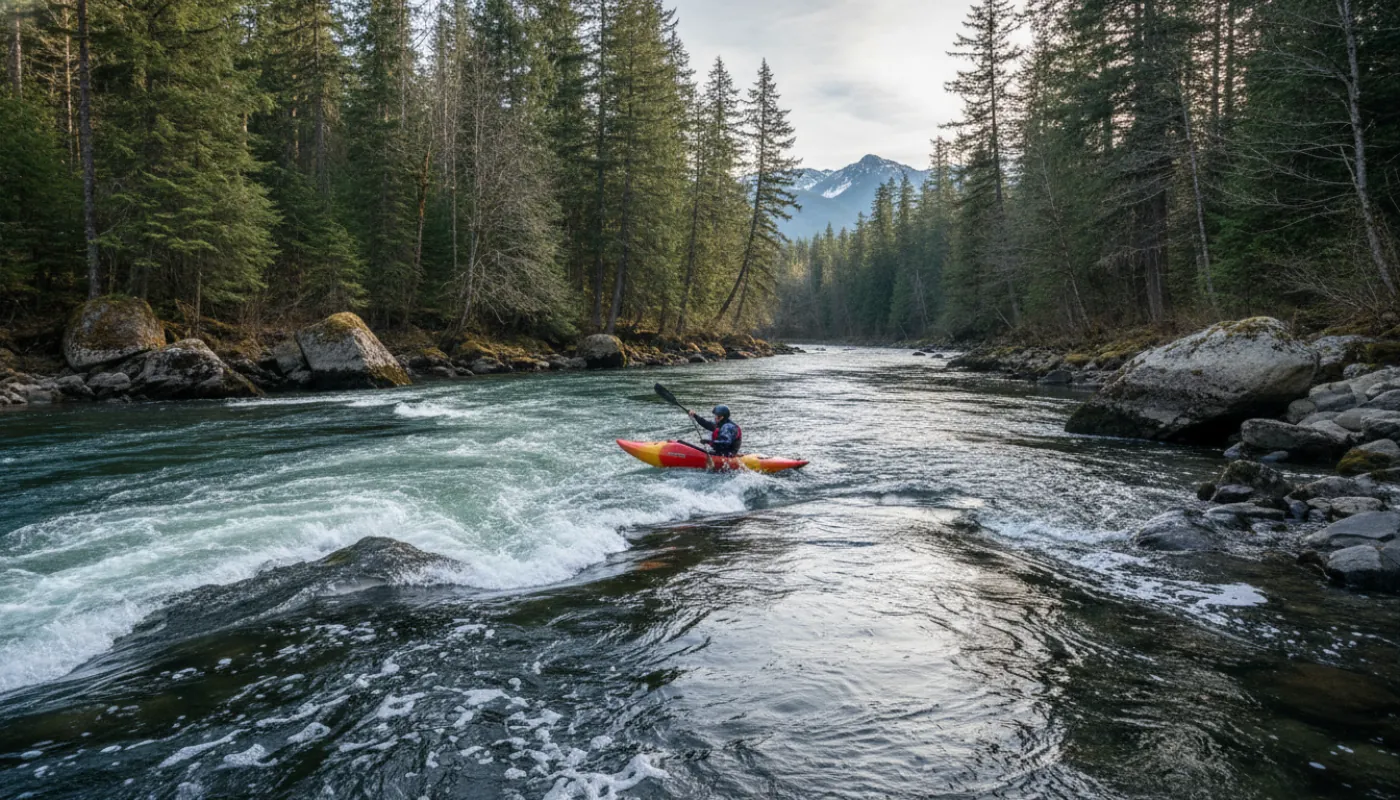
The eddy turn is the move that changes your relationship with the river. Instead of being swept along, you actively plant yourself in calm water, and the eddy line becomes your lever. Enter the eddy aggressively, driving your bow across the shear line at roughly 45 degrees to the current. Your forward paddle and ferry angle should plant the downstream edge of your boat in the calm water while your upstream edge is still in moving current.
Here's the pivot point: that eddy line acts like a hinge. The current pushes your upstream hull while the calm water lets the downstream hull plant, and the boat rotates with almost no paddle input needed. Your weight shifts downstream to prevent a capsize as your boat swings, this is critical. Lean too far upstream and the moving current flips you; lean downstream and you'll feel the boat carve tight. A well-executed eddy turn feels effortless, almost magical; the eddy does the work. Common mistakes: entering at too shallow an angle (the boat doesn't catch the line), paddling backward (which slows your entry), or leaning upstream (which invites a flip). Entry speed matters, a slow, tentative approach drifts you past the eddy line. Commit to the entry with moderate forward speed and a decisive lean. Once your boat swings parallel to the bank, a stroke or two in the calm water stabilizes your new position.
Peeling Out: Leaving Eddies with Authority
The peel out is the eddy turn in reverse. You're now in calm water, facing upstream, and you need to enter the moving water decisively without losing control. The setup: position your boat angled downstream, with your bow 45 degrees into the current. Your paddle should be ready to execute a strong forward stroke the instant you cross the shear line. Drive your bow into the current with authority, hesitation invites the current to grab your upstream edge.
As your boat swings into the flow, the current immediately starts pushing. Your weight shifts downstream, the same downstream lean as the eddy turn, to keep the hull stable against that pressure. A powerful forward stroke completes the pivot and drives you into the rapid, aligned with the current instead of fighting it. Peel outs fail most often from timidity. Tentative entries let the current catch a poorly-angled hull and spin you sideways or push you upstream. The current is strongest at the shear line; your committed entry and downstream lean harness that force instead of resisting it. Once you're through the transition and parallel to the flow, the ferry and eddy turn skills resume. A smooth peel out sets your line for what comes next; a sloppy one costs control immediately.
Practice, Progression, and Safety
These three techniques demand practice in low-risk settings before you apply them to bigger rapids. Start in mild current, a slow river section or a pool with a circulating current works, where mistakes drift you a short distance rather than into hazard. Ferry first, in both directions, until you can feel the boat respond to angle changes and the current becomes predictable. Move to eddies only after ferries feel automatic. Deliberately find small eddies and practice entries from the current, then peel outs back into the flow.
Progression means gentle current, then moderate (class II–III), then reading a section of rapid topography, then combining multiple eddy turns to break a rapid into segments. Never rush this sequence. Whitewater fatalities are documented every year, American Whitewater's accident database is a sobering read, usually in conditions that expose a subtle timing flaw in a technique that wasn't yet reflexive. Your body learns through repetition, not instruction. Practice also means setting conditions: warm water, a friend downstream, a scout-able line, zero pressure. Cold water or entrapment hazards are not learning environments. Even after you're solid, these techniques demand focus. Distraction or fatigue bleeds precision. Wear a PFD, a helmet, and appropriate cold-water gear every time, regardless of confidence level. The current doesn't care how skilled you are; failures happen to expert paddlers when technique lapses. Respect the water's neutral indifference, drill the fundamentals until they're reflexive, and advance gradually into harder conditions.