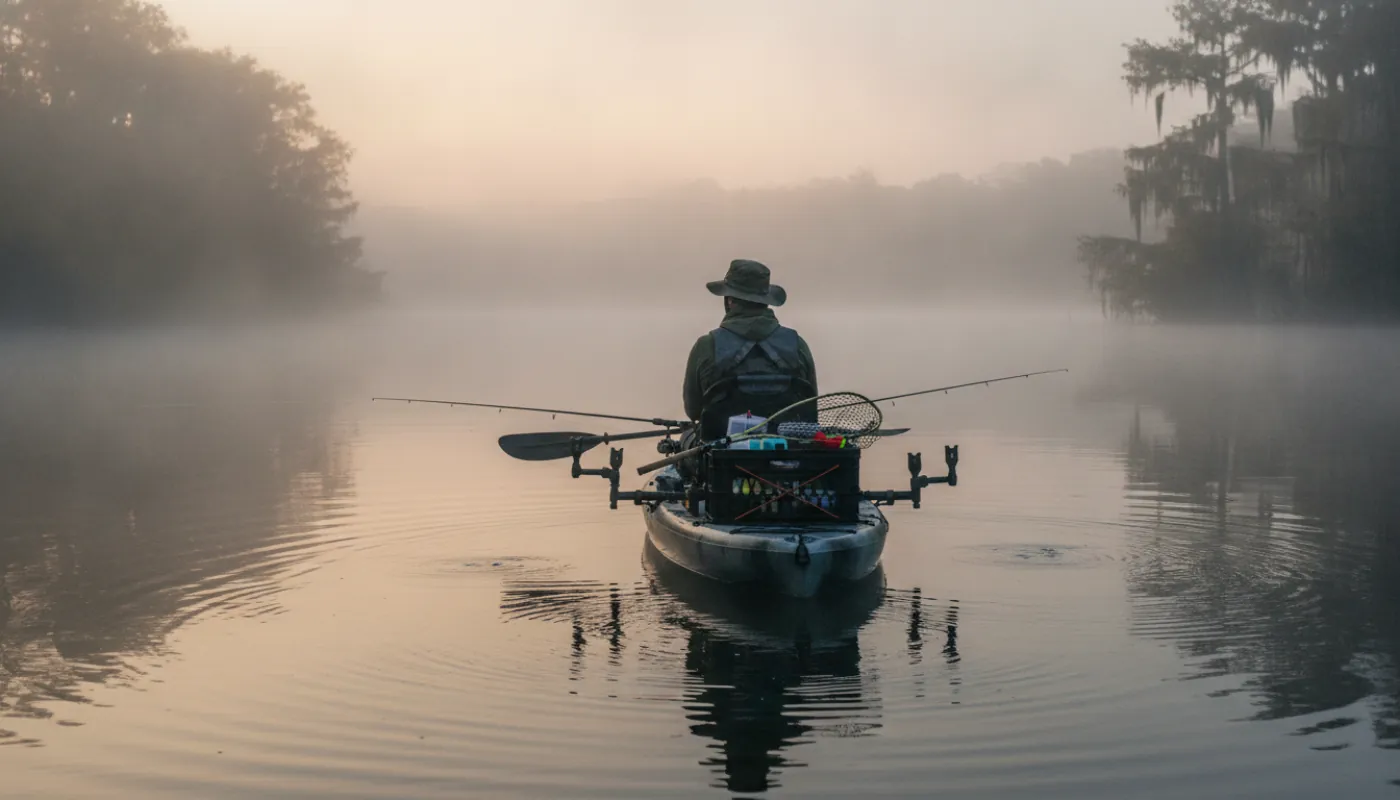
Most fishing-kayak buyers rig the boat twice. The first pass is enthusiastic: every rod holder the deck will accept, a fish finder from the biggest box brand, a milk crate stuffed with tackle. The second pass, usually after a season, is subtractive: half the holders come off, the crate gets swapped for something lower and narrower, and the electronics move to where they don't blind the angler at dawn. This guide is written for that second pass. If you're outfitting a fishing kayak, or reconsidering one you already own, here's what tends to earn its deck space and what tends to come back off.
Nothing here is prescriptive about brands. Setups are shaped by water type (flatwater pond, tidal marsh, big river, coastal bay), by whether you fish standing or seated, and by how far you're willing to carry the loaded boat from truck to launch. Get those three questions answered first; the accessory list follows from them.
Start with the hull, not the accessories
The single decision that governs every rigging choice is the hull. A 12-foot sit-on-top with a wide, flat deck rigs differently than a narrower 14-footer built for open water. Before you spend a dollar on accessories, be honest about where you'll actually fish 80 percent of the time.
Pedal vs paddle fishing kayak
The pedal-versus-paddle debate gets treated like a philosophical question. It's really an ergonomic and access one.
Pedal drives free your hands, which changes everything downstream: you can hold a rod through a retrieve, cast into wind without repositioning, and hover over structure by tapping backward pedals. They add weight (often 10–20 pounds over a comparable paddle boat, counting the drive unit and a heavier hull), draft (the drive unit hangs below the hull), and cost. On skinny water, oyster bars, or shallow grass flats, the drive can foul or ground before the hull does. On big open water where you're covering distance between spots, pedals are hard to beat.
Paddle kayaks are lighter, cheaper, launch anywhere, and don't care about depth. You trade the hands-free retrieve for versatility. If you fish creeks, small ponds, or anywhere with variable depth and lots of obstructions, a paddle boat is usually the smarter tool. Standing platforms, outriggers, and stakeout poles all help you fish a paddle kayak like a pedal one when you're stationary.
Neither is objectively better. Match the drivetrain to the water.
Stability, weight capacity, and standing
If you plan to stand (for sight-casting, for fly work, for launching heavier lures), check the boat's primary stability, not just the spec-sheet weight capacity. Rated capacity is a flotation number, not a "you can fish here" number. A common rule of thumb: leave 30–40 percent of rated capacity as headroom, load to no more than about 60–70 percent if you want to stand comfortably and keep a dry deck (check your manufacturer's guidance). That headroom accounts for you, your gear, a cooler of water and fish, and the wave action you'll actually meet.
The rod-holder question
Rod holders are the accessory people over-buy. Two flush-mount holders behind the seat and one adjustable holder in front of the seat covers the vast majority of freshwater and inshore situations. Trolling boats need more; casting boats need fewer.
Flush-mount vs track-mount
Flush-mount holders are permanent, clean-looking, and don't add clutter above the deck. They're ideal for trolling positions behind the seat where you rarely change angles. The downside is obvious: you cut a hole in your boat.
Track-mount holders (using accessory tracks like the common gear tracks molded into most modern fishing kayaks) are the better choice for anything you want to reposition. Adjustable rod holders in front of the seat should always be track-mounted so you can angle them for different techniques: vertical for jigging, laid-back for trolling, offset for fly line management.
A sensible starting kit:
- Two flush-mount holders behind the seat, angled outward about 30 degrees.
- One adjustable track-mount holder within reach of the seated angler.
- One horizontal rod storage system along the gunwale for the second rigged rod you're not currently using.
Add more only after a season tells you where the holes are.
Rod leashes are not optional
If you fish salt or moving water, leash every rod. Fishing kayaks capsize rarely, but rods go overboard often: a snagged shirt, a rogue wake, a lure that catches the deck on the cast. Cheap coiled leashes tied to a pad eye near each holder pay for themselves the first time.
Anchor trolley: the highest-leverage single addition
If you rig only one thing beyond rod holders, rig an anchor trolley. It's the accessory that most transforms how a fishing kayak actually fishes.
An anchor trolley is a loop of line running through pulleys at the bow and stern, held on one side of the boat, with a ring you can slide fore-to-aft. You clip your anchor (or stakeout pole, or drift chute) to the ring. That lets you shift the anchor point from bow to stern from your seat, which controls how the boat swings in current or wind, critical for keeping your casting angle pointed at the structure you're fishing.
Anchor trolley kayak setup basics
A functional trolley is simple:
- Two small pulleys or pad eyes, one near the bow, one near the stern, mounted on the same side of the boat (usually the non-dominant side so the working line stays out of your casting arc).
- A continuous loop of paracord or braided line running through both.
- A carabiner or O-ring on the loop as the attachment point.
- A cleat amidships to lock the ring in position.
Mount pulleys through-deck with well-nuts or sealed rivets, and bed everything in marine sealant. Deck penetrations without sealant become slow leaks that show up as a wet hatch three months later.
What you anchor with matters
For shallow flats (under about six feet), a stakeout pole is faster and quieter than an anchor and doesn't drag on retrieve. For deeper water or soft bottom, a small folding grapnel anchor with a length of chain and rode is standard. For current, a drift chute (sea anchor) slows drift without pinning you in place. Match the tool to the bottom and the flow.
Electronics: less is more
The temptation is to mount a fish finder that would look at home on a bass boat. Resist it.
A compact fish finder with a transducer mounted through-hull or in a scupper adapter is enough for most kayak anglers. Bigger screens draw more power, take up more deck space, and, critically, put a reflective surface where you're trying to read the water. The screen you can glance at without breaking your fishing rhythm is more useful than one twice the size that you have to actively look at.
Power the unit with a small sealed lead-acid or lithium battery in a dry bag, wired through a fuse. Route the transducer cable along the inside of the hull with adhesive clips, not free-floating where it can snag a hatch or a foot. If you fish salt, rinse the connectors after every trip, corrosion is what kills marine electronics, not the electronics themselves.
The rest of the deck: what earns its space
Everything else on a fishing kayak deserves the same subtractive scrutiny. Here's the shortlist most anglers converge on after a season or two:
| Item | Why it earns space | Common mistake |
|---|---|---|
| Milk crate or purpose-built rear tankwell box | Tackle organization + upright rod storage behind the seat | Buying one too tall; it makes casting over your shoulder awkward |
| PFD with fishing pockets | Wearing it (not stowing it) is what keeps you alive | Choosing a non-fishing PFD and taking it off to work |
| Paddle leash | You will drop the paddle when a fish hits | Skipping this on a pedal boat, you still need the paddle |
| Small dry bag (phone, keys, license) | Waterproof, floats, always in the same spot | Trusting a "water-resistant" hatch instead |
| Landing net with floating handle | Kayak-side landings are awkward without one | Buying a giant boat net that won't stow |
| Fish gripper on a lanyard | Safer than lipping toothy fish over your legs | Leaving it clipped somewhere you can't reach one-handed |
Notice what's not on the list: cup holders, GoPro arms, a second (or third) fish finder, a Bluetooth speaker. Those aren't wrong, they're just downstream of the fundamentals.
Safety, weather, and the water you're actually on
Kayak fishing puts you low to the water in a small craft, often alone, sometimes far from the launch. The U.S. Coast Guard treats kayaks as vessels and its recommendations for PFDs, visibility, and signaling apply. Check the current rules for your state and water body. Cold-water immersion is the underrated killer; the USCG's cold-water threshold is 70°F, so if the water is under about 70°F, dress for the swim you might take, not the paddle you plan, cold-water shock can incapacitate a swimmer in the 50–60°F range within minutes.
Before any trip on moving water, check current flow at the nearest USGS gauge, kayak-fishable ranges vary enormously by river, and local liveries or online paddler communities are the best source for what your specific stretch fishes well at. Coastal anglers should read the NOAA marine forecast for the specific zone, not the generic land forecast; wind against tide can turn a bay from friendly to ugly in an hour.
Tell someone your plan (launch, planned takeout, expected return time), every trip. A paddling float plan is not a formality. It's how search and rescue finds you if the day goes sideways.
Building the setup over time
The best-rigged fishing kayaks look, at a glance, under-rigged. Every accessory has a reason, and nothing is there for show. Buy the hull first, add the anchor trolley and a minimal rod-holder layout second, live with it for a few trips, then add electronics and refinements based on what the fishing actually asks of you.
If you're new to paddling and want to try a fishing kayak before buying, most liveries offer sit-on-top rentals suitable for a few hours of exploratory fishing: a good way to figure out whether pedal or paddle, 12-foot or 14-foot, sit-on-top or hybrid, matches how you actually want to fish. Browse places to paddle to find water near you, and if you're an operator running kayak rentals or guided fishing trips, our listing options put you in front of anglers looking for exactly that.