Most first-time SUP buyers walk into the decision backwards. They pick a board they like the look of, discover on the water that it's twitchy or plowing water, and either blame themselves or quietly stop paddling. The board did that, not you. Get the dimensions right up front and the sport gets dramatically easier, and more fun, from day one.
This guide walks through the four decisions that actually matter: length, width, volume, and hull shape. Then it settles the inflatable-versus-hard question honestly, and closes with what to skip and what's worth spending on.
Start with how you'll actually paddle
Before any dimensions, pin down what you'll do 80% of the time. Board shape is a compromise, and the compromise only works if it's tuned to the paddling you actually do, not the paddling you imagine doing.
Three honest categories cover almost everyone:
- Flatwater cruising and fitness. Lakes, calm bays, protected coves, morning paddles for exercise. This is where most people spend their time.
- All-around recreation. A mix of flatwater with the occasional small-wave bay, river float, or yoga session. You want a board that doesn't say no to anything.
- Specialty use. Surf, whitewater, long-distance touring, race, or SUP fishing. Each of these wants a purpose-built board and a different set of trade-offs than this guide covers.
If you're new to the sport, you're almost certainly in the first two categories. Buy for that reality. A touring board is faster in a straight line but slower to turn and less forgiving in chop, a poor first board even for people who think they want to tour eventually. You can always add a second board later.
Length: the speed-versus-maneuverability dial
Length is the easiest spec to understand and the one people over-index on.
- Under 10 feet: short and maneuverable. Good for surf, whitewater, and small paddlers. Slow and unstable for cruising. Not a first-board choice unless you're specifically buying for waves.
- 10 to 11 feet: the all-around sweet spot. Turns easily, tracks well enough for a long paddle, works for most adult paddlers under most conditions.
- 11'6" to 12'6": touring territory. Faster and straighter tracking, better for covering distance, slightly harder to turn. A good second board or a first board for a taller paddler focused on fitness miles.
- 14 feet and up: race and expedition. Fast in a straight line, demanding to balance, overkill for anyone not chasing a specific goal.
A good default for a first board sits between 10'6" and 11'6". That range forgives a lot of mistakes.
Width: the stability spec that matters most
If length is the spec people over-index on, width is the one they under-index on. Width does more to determine how stable a board feels under your feet than any other single dimension.
- 28–30 inches: narrow. Fast and responsive, but genuinely tippy for a beginner. Skip unless you have prior board-sport experience.
- 31–33 inches: the balanced range. Stable enough for most adults to stand up on day one, still efficient to paddle. This is where the majority of good all-around boards live.
- 34–36 inches: wide and forgiving. Great for larger paddlers, SUP yoga, fishing platforms, and anyone who wants zero-drama stability. Trade-off is a slightly slower, less lively feel.
The rule of thumb: if you're a first-time paddler, a first-time buyer, or both, err at least half an inch wider than you think you need. A stable board you enjoy beats a "faster" board that dumps you in the water.
Volume: the number that ties it all together
Volume, measured in liters, is the single most important spec on a paddleboard and the one most buyers ignore because it's not intuitive.
Volume determines how much weight the board can carry while still riding on top of the water rather than plowing through it. Under-volumed boards sit low, feel sluggish, and get unstable fast. Over-volumed boards ride high, feel corky, and catch wind.
The general starting point most shapers use is roughly 1.5 to 2 liters of volume per kilogram of paddler weight (paddler plus any gear or dog you're bringing) for an all-around board. Touring and race boards run lower ratios; wide, stable platforms run higher. As a practical translation:
| Paddler weight | All-around volume target (approx.) |
|---|---|
| Under 140 lb (65 kg) | 150–190 L |
| 140–180 lb (65–82 kg) | 180–230 L |
| 180–220 lb (82–100 kg) | 220–270 L |
| Over 220 lb (100 kg) | 260 L and up |
These are starting ranges, not absolutes. Your paddling style, gear load, and target water conditions all shift the number. But if a board you're considering falls well below the range for your weight, that's a red flag no amount of marketing copy can fix.
Reputable manufacturers publish volume for every board. If a spec sheet omits it, treat that as a signal about how much the brand actually cares about fit.
Hull shape: planing versus displacement
Two hull shapes cover almost every recreational SUP on the market.
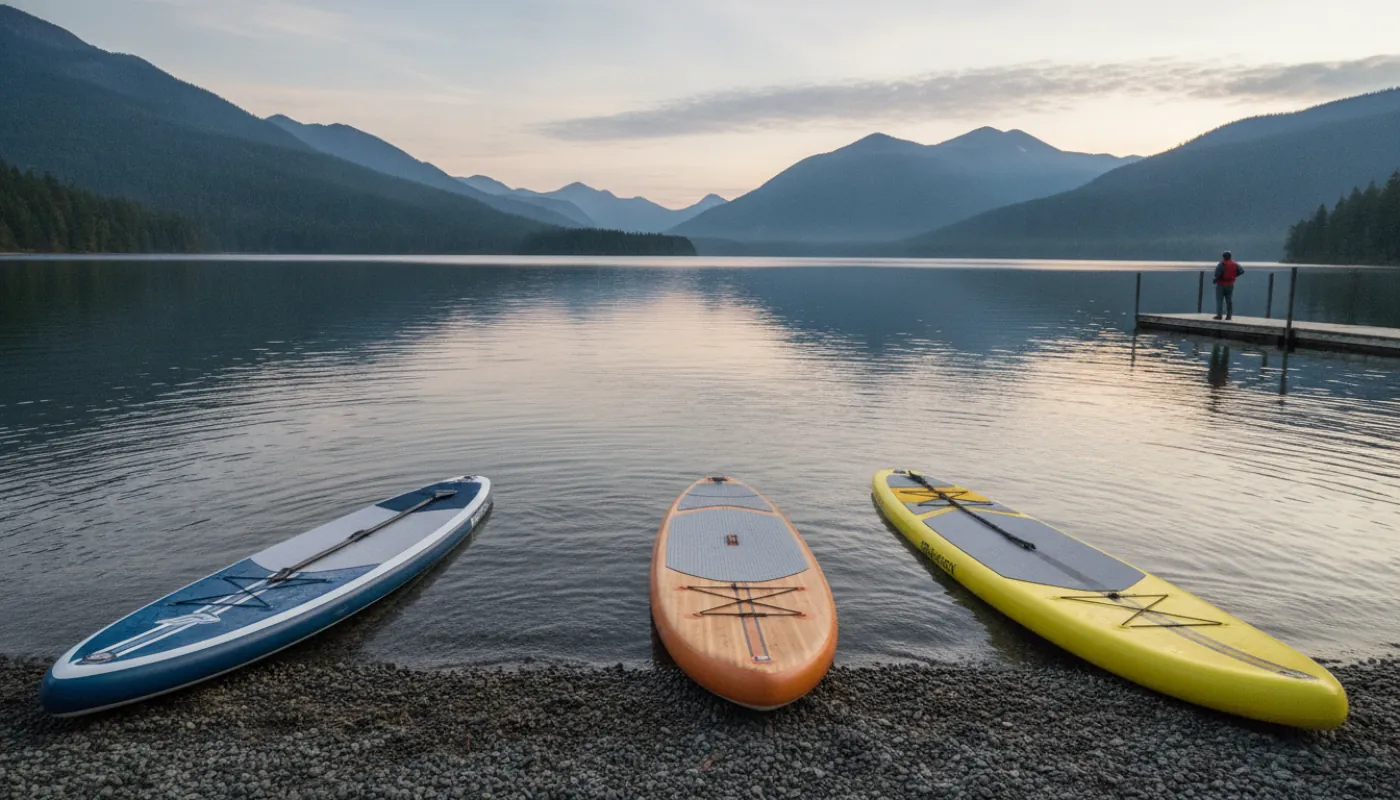
Planing hulls have a flat, wide bottom and a rounded nose. They ride on top of the water, turn easily, and feel stable at low speeds. Almost every all-around and surf-style board uses a planing hull. This is what a first-time buyer wants.
Displacement hulls have a pointed, V-shaped nose that cuts through the water. They're faster, track straighter over distance, and are noticeably less forgiving side-to-side. Touring and race boards use displacement hulls. Great for their purpose; a rough first board.
If you have to ask which one you want, you want a planing hull.
Inflatable versus hard: the honest answer
This is the question every SUP buyer asks, and the honest answer for most people is inflatable. Not because inflatables are always better, but because the trade-offs favor them for the way most people actually use a paddleboard.
Where inflatables win
- Storage and transport. A rolled-up inflatable fits in a closet or the trunk of a sedan. A hard board needs a garage, a shed, or roof racks and a lifting plan. This alone kills more paddleboard ownership than any other single factor.
- Durability against dings. Drop an inflatable on gravel and nothing happens. Do that with an epoxy hard board and you're patching it.
- Travel. Inflatables fly as checked luggage. Hard boards need a specialty carrier or a rental at your destination.
- Price at the entry level. A decent inflatable costs less than a comparable-quality hard board.
Where hard boards win
- Performance. A quality hard board is stiffer, faster, and more responsive on the water. If you're paddling seriously (surf, touring miles, race), this gap gets real.
- Cold water. Rigid construction doesn't lose pressure in cold air the way an underinflated iSUP can.
- Longevity of feel. Good epoxy construction paddles the same in year ten as year one. Inflatables slowly soften with heavy use and UV exposure.
For a first board that will live in an apartment, get carried to the water in a backpack, and see mostly flatwater weekends, buy an inflatable. If you have garage space, a roof rack, and specific performance goals, a hard board earns its keep.
What separates a good inflatable from a bad one
- Construction: dual-layer or fusion-laminated PVC, not single-layer. Woven drop-stitch core, not knitted.
- Pressure rating: match it to the board type rather than chasing a number: all-around boards are typically rated 12–15 PSI, performance and touring boards 15–18 PSI, and race boards 18+ PSI. Always inflate to the maximum printed near the valve and no further. Under-pressurized boards flex in the middle and paddle terribly; over-inflating past the rated max is how seams fail.
- Included pump: a double-chamber hand pump at minimum. A budget single-action pump turns setup into a workout.
What to skip and what to spend on
A few honest calls after the board itself:
Worth the money. A well-fitted personal flotation device, a paddle sized to roughly 8–10 inches over your height (adjustable if you're sharing), and a leash matched to your water. The U.S. Coast Guard classifies SUPs as vessels outside surf zones, so a PFD isn't optional gear.
Moving water changes the leash rules, this one matters. On any river or current, use a purpose-built quick-release SUP leash worn at the waist, never the ankle. A leash that snags on a strainer or rock will hold you underwater against the current, and you cannot reach an ankle attachment once that happens. Practice the release before you need it. Many river paddlers prefer coiled leashes precisely because they keep the cord up out of the water. Flatwater is far more forgiving, but if you are heading into moving water, confirm current guidance with a qualified whitewater SUP instructor or the American Canoe Association.
Worth researching before buying. Fin setup. Most all-around boards come with a large center fin plus two small side bites; that setup covers most water. Whitewater and surf-specific fin configurations are different conversations.
Skip at first. Electric pumps (nice, not necessary), premium carbon paddles (a solid fiberglass paddle is 90% of the experience for a third of the price), and any "beginner package" that bundles a cheap paddle and a single-layer board at a discount.
Before you buy: paddle first if you can
The single best thing a first-time SUP buyer can do is take a lesson or a rental session on two or three different boards before committing. Width and volume differences that look identical on a spec sheet feel completely different underfoot. A morning at a local SUP school is worth more than a week of forum research, and it's how most experienced paddlers ended up on the boards they own. Browse paddling operators in your area, most rent boards by the hour and many will let you demo before you buy.
Get the dimensions right, buy from a brand that publishes real specs, and the board becomes the least interesting part of the experience, which is exactly what you want.